1-MCP (1-methylcyclopropene) is a small synthetic gas that delays the ripening of fruit and the wilting of vegetables and cut flowers. It is an ethylene inhibitor: it occupies the receptor that the plant hormone ethylene needs, so for a while the produce no longer responds to the signal to ripen.
As a post-harvest treatment it works only in an enclosed space, such as a sealed carton, cold room or container, and its effect is a delay, not a stop.
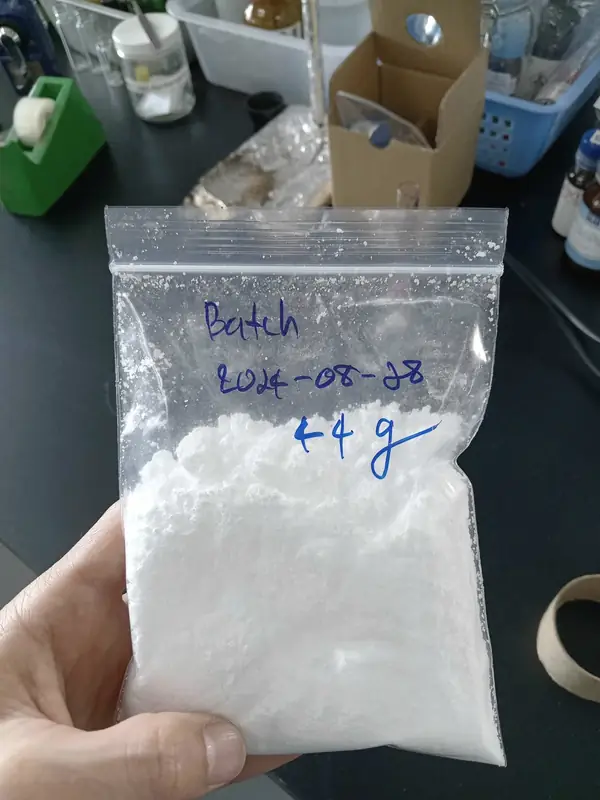
CHON Chemical synthesises 1-MCP in Thailand and supplies it as FreshTrap, a 0.03% sachet (0.5 g).
Absorbers remove ethylene from the air and ripening agents add it; 1-MCP blocks the response to it.
Where the molecule stands with regulators, market by market, is set out under international status.
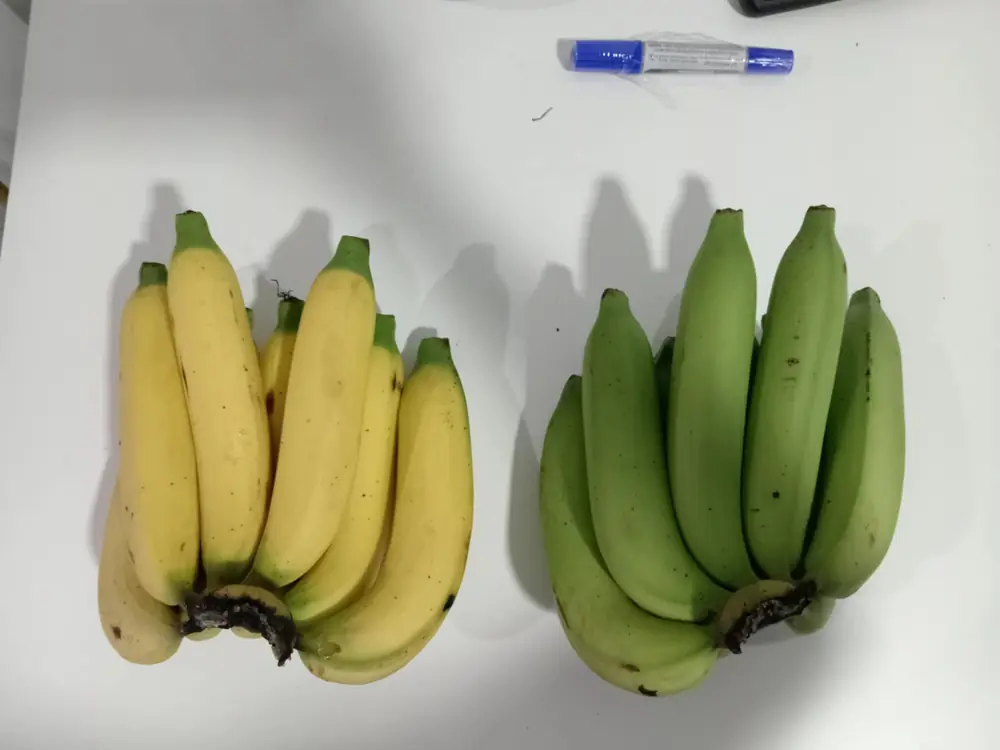
ControlFreshTrap
In-house trial · CHON Chemical
Same crop, same storage, same day
Bananas stored the same way for the same time: the untreated control has ripened (left); the FreshTrap-treated fruit is still green (right).
Control and treated lots stored under the same conditions and photographed from day 0. Results depend on the crop and on storage conditions.
The ripening signal
Ethylene: the hormone that tells produce to ripen
Ethylene is the natural hormone that tells produce and flowers to ripen and wilt.
Ethylene is a gas. Produce makes its own, and it also responds to ethylene in the air around it, which is how one ripening fruit can hurry the fruit packed around it. When ethylene binds its receptor in the plant tissue, the signal goes on: fruit softens and changes colour, leaves turn yellow, and flowers wilt, fade and drop.
Climacteric fruit, such as durian, mangosteen, mango, banana and papaya, go on ripening after harvest, and ethylene drives that ripening. For a shipper, that sets the clock: every day between the packing table and the buyer's shelf is a day of ripening. 1-MCP does not take ethylene away. It holds back the produce's response to it.
How it works
How 1-MCP works: it takes the ethylene receptor
1-MCP is known as an ethylene blocker, or ethylene action inhibitor. It works at the receptor, not in the air: it occupies the plant's ethylene receptors, so the ripening signal is held back, whether the ethylene comes from the air around the produce or from the produce itself.
01
Ethylene gives the signal
Ethylene binds its receptor in the plant tissue, and the tissue ripens, yellows or wilts.
02
1-MCP takes the receptor
1-MCP binds the same receptor about 10 times more strongly than ethylene itself (Blankenship & Dole 2003), so while 1-MCP holds the receptor, ethylene cannot switch the signal on.
03
New receptors bring the signal back
Over the following days the plant forms new receptors (Hu et al. 2017), and ripening resumes. That is why 1-MCP delays ripening rather than stopping it.
1-MCP is one molecule whoever makes it. What differs between 1-MCP products is how much each one declares, how carefully it is made and checked, the carrier that holds the gas and how it is released, and the dose used. How strongly the molecule binds the receptor is the same.
Schematic, not to scale. Receptor binding: Blankenship & Dole (2003). New receptors: Hu et al. (2017).
A gas cannot sit in a sachet on its own. In FreshTrap, 1-MCP is held in α-cyclodextrin powder, and moisture releases it: misting the sachet with water starts the release.
02
Released into a sealed space
In a sealed carton, cold room or container, the gas stays around the produce and reaches every fruit and stem. Treat for 12–24 hours.
03
Opened, stored and shipped as usual
After the treatment the space is opened and the gas dissipates. Then store and ship as usual.
In open air the gas disperses before it can reach the produce, which is why the treatment is done in a closed space; when the US EPA registered 1-MCP in April 1999, it was for use in enclosed spaces only. Step-by-step instructions for the sachet are in how to use FreshTrap.
Published research on 1-MCP — not FreshTrap results
1-MCP delays ripening; it does not stop it
1-MCP delays ripening rather than stopping it; plants gradually form new receptors. A treatment's effect wears off with time.
New receptors bring the signal back
After a treatment the plant gradually forms new ethylene receptors, and ripening resumes (Hu et al. 2017). Treated fruit still ripens, later, for the buyer.
Published research on 1-MCP, not FreshTrap results — Hu et al. 2017, BioResources 12(1):2234–2248
The aim is a delay, not a block
For most fruit, the dose and timing have to delay ripening without blocking it (Watkins 2008). Too much, or badly timed, and fruit can ripen unevenly; bananas are a known case (Wasala et al. 2021). That is why we publish no dose table.
Published research on 1-MCP, not FreshTrap results — Watkins 2008, HortScience 43:86–94; Wasala et al. 2021, Asian Res. J. Agric. 14(1):44–56
Maturity, cultivar and temperature decide the result
How well a treatment works depends on the maturity of the produce, the dose, the cultivar, the temperature, the packaging and the timing (Satekge & Magwaza 2022). Across 292 published studies of climacteric fruit, treatments of about 1 µL/L(1 ppm) for 12–24 hours worked best, and some species, mango among them, responded less consistently (Zhang et al. 2020). Those are researchers' doses for their own conditions, not a FreshTrap recommendation.
Published research on 1-MCP, not FreshTrap results — Satekge & Magwaza 2022, Int. J. Fruit Sci. 22:595–607; Zhang et al. 2020, Hortic. Res. 7:208
It does not control rot
1-MCP slows ripening and ageing but does not control decay (Watkins 2006). Keep your temperature control, hygiene and careful handling; the treatment adds to them rather than replacing them.
Published research on 1-MCP, not FreshTrap results — Watkins 2006, Biotechnol. Adv. 24:389–409
Limits
Which crops respond to 1-MCP, and which do not
1-MCP can only hold back what ethylene drives. It works on climacteric fruit and ethylene-sensitive cut flowers, and it does not help fruit whose ripening is not driven by ethylene.
Durian, mangosteen, mango, banana and papaya go on ripening after harvest, and ethylene drives it, so there is a signal for 1-MCP to hold back. Crop guides: durian and banana.
Responds
Ethylene-sensitive cut flowers
Dendrobium, Mokara and Vanda orchids among them. Cut orchids are where 1-MCP is already in established commercial use in Thailand. See cut flowers and orchids.
Varies
Flower cultivars differ
The response varies by cultivar: published research found only a modest vase-life gain in Dendrobium 'Red Sonia' (Sapbua et al. 2013), and no gain in some rose cultivars (Moody et al. 2014).
Published research on 1-MCP, not FreshTrap results — Sapbua et al. 2013; Moody et al. 2014
Mixed evidence
Leafy vegetables and herbs
Published research is mixed: Chinese cabbage showed no shelf-life gain (Porter et al. 2005), and leafy vegetables often benefit only under heat or ethylene stress (Watkins 2008). We report our own trials on greens separately, as in-house results, on vegetables and herbs.
Published research on 1-MCP, not FreshTrap results — Porter et al. 2005; Watkins 2008
Does not help
Non-climacteric fruit
1-MCP does not help non-climacteric fruit such as longan, rambutan, young coconut, citrus and strawberry. Their ripening is not driven by ethylene. In published research on non-climacteric fruit, the effects of 1-MCP were small and mostly on green tissue (Li et al. 2016); in grapefruit it slowed degreening but raised respiration and ethylene production (McCollum & Maul 2007).
Published research on 1-MCP, not FreshTrap results — Li et al. 2016; McCollum & Maul 2007
Occupies the ethylene receptor in the produce, so the tissue no longer responds to ethylene
Removes ethylene from the air around the produce
Supplies ethylene to start ripening
Effect on ripening
Delays it
Can slow it, by keeping ethylene in the air low
Starts it or speeds it up
Ethylene the produce makes itself
Blocks the response to it too
Cannot reach it inside the produce; lowers only what is in the air
Adds more
How it is used
A small amount released once, typically for 12–24 hours in an enclosed space
Stays in the pack for the whole journey; its capacity is used up over time
Dipping, spraying or gassing, in ripening rooms
Typical use
Before storage and transport, to delay ripening and wilting
Long journeys and mixed loads
Ripening rooms, for example for bananas and mangoes
Sources for the 1-MCP column: US EPA1-MCP fact sheet; Watkins 2006; Blankenship & Dole 2003.
A common mix-up: 1-MCP is often described as an ethylene absorber. It is not; it removes no ethylene from the air. The two can work together: after a 1-MCP treatment, an absorber can keep ethylene in the air low during a long journey. Neither replaces temperature control. Absorber sachets based on potassium permanganate contain an oxidiser and must not touch the food.
International status
Where 1-MCP stands with regulators
Everything in this list is about the molecule, 1-MCP, not about FreshTrap. A molecule's status and a product's status are different things: in the US, for example, registration is per product.
1-MCP has been registered by the US EPA since April 1999; that registration was for use in enclosed spaces only (US EPA fact sheet). US registration is per product: the active ingredient is registered by the US EPA in other companies' products; FreshTrap is not EPA-registered.
United States: residues
The US EPA exempts 1-MCP residues on fruit and vegetables from a tolerance (40 CFR 180.1220, 2002). The exemption is US law; other markets set their own rules.
European Union
EU approval of 1-MCP as an active substance runs to 31 July 2034(Reg. (EU) 2019/1085).
Codex Alimentarius
There is no Codex MRL for 1-MCP: the molecule is not in the Codex pesticide index (checked 26 September 2026).
Organic produce
1-MCP is not permitted in USDA-certified organic handling (USDA AMS). Other organic certifiers set their own rules; check with yours.
Registration with Thailand's Department of Agriculture is in progress. For residue questions on your destination market, ask us — and check that market's own rules. Handling, residues and safety are set out in full on safety and regulation.
From CHON Chemical
FreshTrap: 1-MCP synthesised and verified in Thailand
FreshTrap is CHON Chemical's 1-MCP sachet: high-purity1-methylcyclopropene held in α-cyclodextrin,0.03%1-MCP in each 0.5 g sachet.
We synthesise the 1-MCP in a closed system and capture it in α-cyclodextrin powder; moisture releases it. How we make and check it is on technology and quality.
CHON Chemical is a Thai chemical-synthesis company, founded from a collaboration with researchers and faculty of the Department of Chemistry, Faculty of Science, Chulalongkorn University. FreshTrap is our first product: see our products, and more about CHON Chemical.
A 0.03% sachet, 0.5 g: Supplied in a 400 g stand-up pouch of 800 sachets. Tablet and powder formats on request.
Checked every batch: Structure confirmed by NMR, content measured by GC-MS.
A dose set with you: The dose depends on the sealed volume, the crop and the journey time — we set it with you.
What to expect: In our in-house trials, produce stayed saleable for 7–20 extra days depending on the crop and on storage conditions. (In-house trial · CHON Chemical)
FreshTrap is 1-MCP in a 0.03% sachet, synthesised and verified in Thailand. See the product, or try it in a monitored trial: control and treated lots packed the same day, stored the same way and photographed from day 0, with the dose set with you.
Published research on 1-MCP, not FreshTrap results
Blankenship & Dole (2003). Postharvest Biology and Technology 28:1–25. doi:10.1016/S0925-5214(02)00246-6 — 1-MCP binds the receptor about 10× more strongly than ethylene; review.
Hu et al. (2017). BioResources 12(1):2234–2248 — plants form new receptors over time; the effect is a delay (review). bioresources.cnr.ncsu.edu
Watkins (2006). Biotechnology Advances 24:389–409. doi:10.1016/j.biotechadv.2006.01.005 — review: 1-MCP slows senescence but does not control decay.
Watkins (2008). HortScience 43:86–94. doi:10.21273/HORTSCI.43.1.86 — the dose must delay ripening, not block it; leafy vegetables often benefit only under heat or ethylene stress.
Satekge & Magwaza (2022). International Journal of Fruit Science 22:595–607. doi:10.1080/15538362.2022.2085231 — efficacy depends on maturity, dose, cultivar, temperature, packaging and timing.
Zhang, Ma, Dong, Terry, Watkins, Yu (2020). Horticulture Research 7:208. doi:10.1038/s41438-020-00405-x — meta-analysis of 292 papers: about 1 µL/L for 12–24 h worked best for climacteric fruit; mango responded less consistently.
Wasala W.M.C.B. et al. (2021). Asian Research Journal of Agriculture 14(1):44–56. doi:10.9734/ARJA/2021/v14i130118 — banana review: response depends on maturity; uneven ripening possible, so the dose must be controlled.
Li L., Lichter A., Chalupowicz D. et al. (2016). Postharvest Biology and Technology 111:322–329. doi:10.1016/j.postharvbio.2015.09.031 — non-climacteric fruit: effects small, mostly on green tissue.
McCollum G., Maul P. (2007). HortScience 42:120–124. doi:10.21273/HORTSCI.42.1.120 — citrus: 1-MCP slowed degreening but raised respiration and ethylene production.
Porter K., Collins G., Klieber A. (2005). Journal of the Science of Food and Agriculture 85:293–296. doi:10.1002/jsfa.1955 — Chinese cabbage: no shelf-life gain.
Sapbua D., Samniangdee P., Uthairatanakij A., Buanong M. (2013). Acta Horticulturae 970:217–221. doi:10.17660/ActaHortic.2013.970.24 — Dendrobium 'Red Sonia': a modest vase-life gain; results vary by cultivar.
Moody E.P., Dole J.M., Barnes J. (2014). HortTechnology 24:676–685. doi:10.21273/HORTTECH.24.6.676 — some rose cultivars showed no vase-life gain: the response is cultivar-dependent.
Regulatory source (about the molecule, not FreshTrap)
US EPA.1-Methylcyclopropene pesticide fact sheet (PC code 224459), 2009 revision — first registered April 1999; enclosed spaces; low toxicity. www3.epa.gov
40 CFR §180.1220 — 1-methylcyclopropene; exemption from the requirement of a tolerance (US residue exemption, 2002). law.cornell.edu
Commission Implementing Regulation (EU) 2019/1085 — EU approval of 1-MCP as an active substance to 31 July 2034.eur-lex.europa.eu
FAO/WHO Codex Alimentarius pesticide index (checked 26 September 2026) — no Codex MRL for 1-MCP.fao.org
USDA AMS, petitioned substance 1-methylcyclopropene — not permitted in USDA-certified organic handling. ams.usda.gov
Last updated
CHON ChemicalSynthesis services · FreshTrapHello! Ask us about a synthesis, a sample or FreshTrap. We reply as soon as we can.