1-MCP for cut flowers and orchids: holding back flower drop on the way to the vase
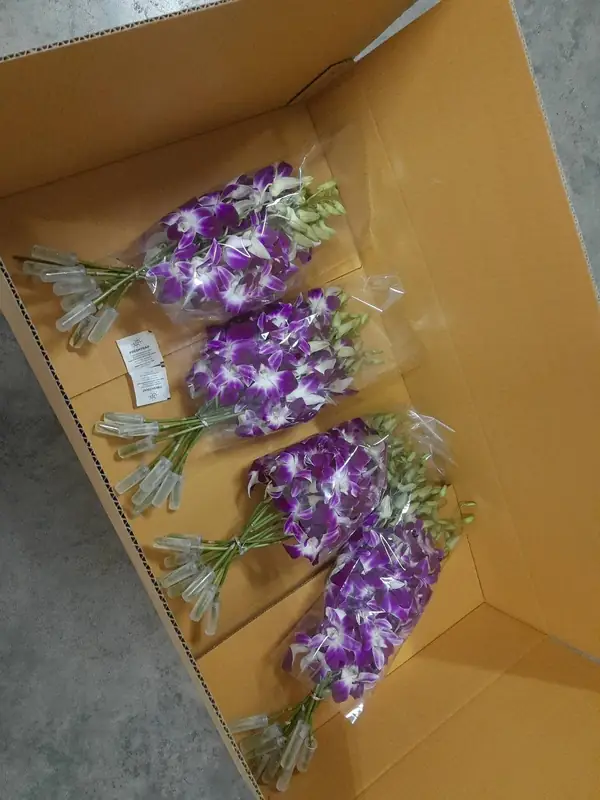
1-MCP (1-methylcyclopropene) helps extend orchid vase life by holding back the ethylene signal that makes cut flowers drop buds and florets, fade and wilt. FreshTrap, CHON Chemical's 1-MCP sachet, treats the flowers inside the sealed export carton before they travel.
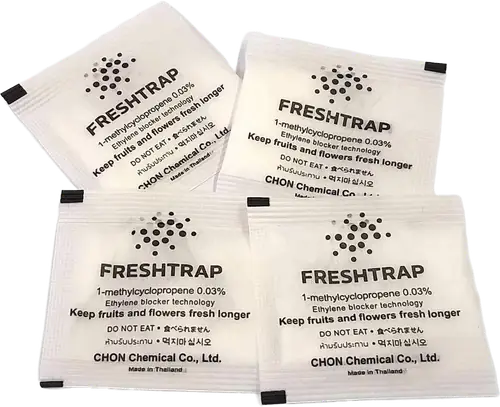
Cut orchids are where 1-MCP is already in established commercial use in Thailand. FreshTrap is 1-methylcyclopropene held in α-cyclodextrin, supplied as a 0.03% sachet (0.5 g) and synthesised and verified in Thailand.
Why cut orchids lose vase life between the packhouse and the buyer
Ethylene-sensitive orchids can respond to ethylene by shedding buds and florets, fading and wilting.
For an orchid exporter, what counts is how the sprays look when the importer opens the box, and how long they last in the vase after that. The aim of a 1-MCP treatment is a longer vase life at the buyer's end and less drop in the box.
1-MCP blocks the response to ethylene at the receptor; an ethylene absorber (a KMnO₄ sachet) works differently, removing ethylene from the air. 1-MCP binds the ethylene receptor about 10 times more strongly than ethylene itself (Blankenship & Dole 2003).
It works only in an enclosed space — a sealed carton, cold room or container. How 1-MCP works explains the mechanism in full.
Published research on 1-MCP — not FreshTrap results
What published research says about 1-MCP and orchid vase life
Independent studies of the active ingredient on Dendrobium and Mokara orchids, quoted with the treatment each research team used. The doses are the researchers' own; they are not a FreshTrap recommendation.
Dendrobium 'Sonia': 32 days in the vase against 20
Cut 'Sonia' Dendrobium treated with 0.2 µL/L1-MCP for 6 hours at 25 °C had a vase life of 32 days, against 20 days for untreated flowers (Le et al. 2018).
Mokara 'Chao Praya Pink': vase life from 14 to 21 days
Mokara 'Chao Praya Pink' treated with 10 ppm1-MCP for 4 hours at 25 °C had a vase life of 21 days, against 14 days for untreated flowers (Nur Azlin et al. 2013).
Dendrobium 'Khao Sanan': half the flowers deteriorated by day 13, not day 6
Cut 'Khao Sanan' Dendrobium treated with 500 ppb1-MCP for 3 hours at 25 °C reached 50% flower deterioration on day 13; untreated flowers reached it on day 6 (Kasetsart University / Postharvest Technology Innovation Center 2022).
The response depends on the cultivar. In 'Red Sonia' Dendrobium treated with 200 nL/L1-MCP for 6 hours at 20 °C, the gain was small: 19.3 days in the vase against 17.4 (Sapbua et al. 2013). Beyond orchids, some rose cultivars showed no vase-life gain from 1-MCP (Moody et al. 2014). That is why the treatment is checked on your own variety before a full shipment.
These studies show what the active ingredient can do against ethylene damage in these orchids. How FreshTrap performs on your variety, in your cartons and on your route is what a monitored trial on your own flowers finds out.
From the FreshTrap datasheet
Cut orchids: where 1-MCP is already in commercial use
FreshTrap puts that treatment in a sachet synthesised and verified here.
We show this pair without a figure. Every orchid result on this page comes from published research and is labelled as such; the number for your variety, your cartons and your route comes from a monitored trial on your own flowers.
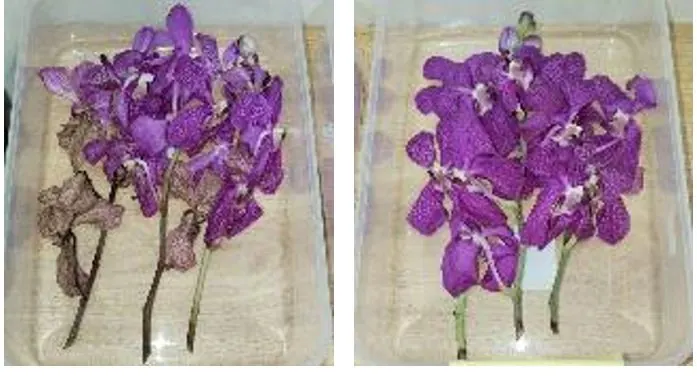
Vanda: control and FreshTrap
Photo pair from our product datasheet: purple Vanda in trays, the untreated control on the left and the FreshTrap tray on the right.
At the packing table
How FreshTrap fits an orchid packhouse
Dose, concentration, format and method are tailored to your carton size and journey time, so the first step with a new orchid customer is a monitored trial: treated and untreated cartons packed the same day, sent the same way and photographed from day 0.
Keep the pouch sealed and dry until the sachet goes into the carton: moisture is what releases the gas. Full directions and handling notes are on how to use FreshTrap.
Where 1-MCP helps cut flowers, and where it does not
1-MCP holds back one signal, ethylene. It is not a cure-all for cut flowers.
It delays; it does not stop
1-MCP delays ripening and wilting rather than stopping them for good: plants gradually form new receptors, so the effect of treatment wears off with time (Hu et al. 2017).
Published research on 1-MCP, not FreshTrap results — Hu et al. 2017, BioResources 12(1):2234–2248
Ethylene-sensitive flowers only
It helps flowers whose ageing is driven by ethylene, such as Dendrobium, Mokara and Vanda orchids. The response varies by cultivar, and some cut flowers gain little or nothing, as the published results above show.
Enclosed spaces only
An open bucket or a display shelf is not a treatment.
Not a substitute for the cold chain
1-MCP slows ageing but does not control decay (Watkins 2006).
Published research on 1-MCP, not FreshTrap results — Watkins 2006, Biotechnol. Adv. 24:389–409
Registration with Thailand's Department of Agriculture is in progress. The active ingredient, 1-MCP, is registered by the US EPA in other companies' products; FreshTrap is not EPA-registered. For questions about your destination market, ask us — and check that market's own rules.
1-MCP acts on a plant receptor; its toxicity to people and animals is low (oral LD50 in rats above 5,000 mg/kg — a literature value for 1-MCP). Wear gloves and eye protection when handling the concentrated powder. Store in a cool, dry place in the original packaging; keep out of reach of children; not near food or feed. More on safety and regulation.
Safety positioning is based on the published international record for 1-MCP and on CHON Chemical's own batch analysis; it is not a regulatory claim pending completion of Department of Agriculture registration.
Published research on 1-MCP — not FreshTrap results. Regulatory lines describe the active ingredient 1-MCP, not FreshTrap.
Le S.N., Nguyen N.V.P., Nguyen T.T. (2018). Acta Horticulturae 1213:587–598. doi:10.17660/ActaHortic.2018.1213.89 — Dendrobium 'Sonia': 0.2 µL/L, 6 h, 25 °C → vase life 32 vs 20 days.
Nur Azlin R. et al. (2013). Acta Horticulturae 1012:589–592. doi:10.17660/ActaHortic.2013.1012.79 — Mokara 'Chao Praya Pink': 10 ppm, 4 h, 25 °C → vase life 14 → 21 days.
Kasetsart University, Department of Horticulture / Postharvest Technology Innovation Center (2022). Postharvest Newsletter 21(3) — Dendrobium 'Khao Sanan': 500 ppb, 3 h, 25 °C → 50% flower deterioration on day 13 vs day 6 untreated. phtnet.agri.cmu.ac.th
Sapbua D., Samniangdee P., Uthairatanakij A., Buanong M. (2013). Acta Horticulturae 970:217–221. doi:10.17660/ActaHortic.2013.970.24 — Dendrobium 'Red Sonia': 200 nL/L, 6 h, 20 °C → a modest gain (19.3 vs 17.4 days); results vary by cultivar.
Moody E.P., Dole J.M., Barnes J. (2014). HortTechnology 24:676–685. doi:10.21273/HORTTECH.24.6.676 — Some rose cultivars do not respond to 1-MCP; the response is cultivar-dependent.
Blankenship & Dole (2003). Postharvest Biology and Technology 28:1–25. doi:10.1016/S0925-5214(02)00246-6 — 1-MCP binds the receptor about 10× more strongly than ethylene; review.
Hu et al. (2017). BioResources 12(1):2234–2248 — plants form new receptors over time; the effect is a delay (review). bioresources.cnr.ncsu.edu
Watkins (2006). Biotechnology Advances 24:389–409. doi:10.1016/j.biotechadv.2006.01.005 — review: 1-MCP slows senescence but does not control decay.
US EPA.1-Methylcyclopropene pesticide fact sheet (PC code 224459), 2009 revision — first registered April 1999; enclosed spaces; low toxicity. www3.epa.gov
CHON ChemicalSynthesis services · FreshTrapHello! Ask us about a synthesis, a sample or FreshTrap. We reply as soon as we can.