
FreshTrap · Directions for use
How to use FreshTrap: the 1-MCP sachet treatment, step by step
To use a FreshTrap 1-MCP sachet, place it with the produce, mist it with water, seal the carton or space, leave it closed for 12–24 hours, then store and ship as usual.
FreshTrap is CHON Chemical's 1-MCP sachet: 1-methylcyclopropene held in α-cyclodextrin, 0.5 g per sachet at 0.03%. The only equipment you need is a hand mist sprayer. The treatment works only in an enclosed space, and the dose depends on the sealed volume, the crop and the journey time, so we set it with you. Product details are on the FreshTrap page.

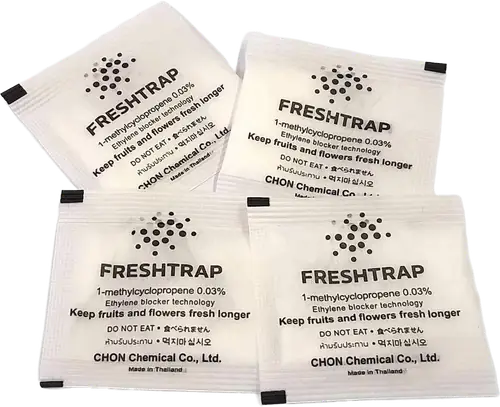
12–24 hoursin a sealed carton, cold room or container
One hand mist sprayerthe only equipment you need
Before you start
What you need at the packing table
Have these ready before you open the pouch.
- Produce packed as usual: In the carton, parcel or space you are going to treat.
- FreshTrap sachets, still dry: Kept in their closed pouch until the moment you use them.
- A hand mist sprayer and water: No gas cylinders, no generator, no fitting work on the room.
- A space you can close for 12–24 hours: A sealed carton, a cold room or a container.
- The dose for your load: Set for your crop, your carton and your journey. If we have not set it together yet, start with a trial.
Directions
The treatment in five steps
Place the sachet → mist it with water to start the release → seal → leave 12–24 hours → store and ship as usual.
- Step 1
Place the sachet
Put the sachet in with the produce, inside the export carton or parcel before you close it. Take the sachets you need for the batch out of the pouch and close the zip again straight away: moisture is what releases the gas, so the rest must stay dry. Treating a whole cold room or container instead? The tablet and powder formats are supplied on request, and we plan the method with you.
- Step 2
Mist it with water
Mist the sachet with water from a hand mist sprayer until it is wet. Water frees the 1-MCP gas from its α-cyclodextrin carrier, so this is the moment the treatment starts. Mist, then close up without delay.
- Step 3
Seal
Close the carton and tape it shut, or close the door of the room or container. 1-MCP works only in an enclosed space. The gas has to stay with the produce for the whole treatment, so the space stays closed until the time is up.
- Step 4
Leave 12–24 hours
Keep everything closed for 12–24 hours. There is nothing else to do. Sealed in, the gas stays around the produce and occupies the plant's ethylene receptors, so the ripening signal is held back.
- Step 5
Store and ship as usual
When the 12–24 hours are up, open, ventilate and carry on with your normal cold chain. Store and ship as you always do. The treatment itself is over before the journey starts.
Dose
How many sachets? We set the dose with you
The dose depends on the sealed volume, the crop and the journey time, so it is set case by case.
Tell us about the load
Your crop, how it is packed (carton, cold room or container) and how long the journey takes.
We set the dose and treat with you
We design the dose for your crop and carton and run the first treatment together.
Compare side by side
Same crop, same storage, same day, side by side. Control and treated lots stored under the same conditions and photographed from day 0.
Dose, concentration, format and method are tailored to your container size and journey time. That is why this page carries no sachets-per-carton chart: a figure that suits one crop in one carton can be wrong for another, and published research shows that the dose matters (see what affects the result). We set it in a monitored trial on your own crop.
Published research on 1-MCP — not FreshTrap results
What affects the result
Published research finds that how well a 1-MCP treatment works depends on the maturity of the produce, the dose, the cultivar, the temperature, the packaging and the timing (Satekge & Magwaza 2022).
The dose has to delay, not block
For most fruit the aim is a dose that delays ripening without blocking it (Watkins 2008). In bananas the response depends on maturity, and ripening can turn uneven when the dose is not controlled (Wasala et al. 2021).
Published research on 1-MCP, not FreshTrap results — Watkins 2008, HortScience 43:86–94; Wasala et al. 2021, Asian Res. J. Agric. 14(1):44–56
Crops respond differently
A meta-analysis of 292 papers found that some climacteric fruit, mango among them, respond less consistently than others (Zhang et al. 2020). 1-MCP does not help non-climacteric fruit such as longan, rambutan, young coconut, citrus and strawberry, whose ripening is not driven by ethylene; published effects there are small (Li et al. 2016).
Published research on 1-MCP, not FreshTrap results — Zhang et al. 2020, Hortic. Res. 7:208; Li et al. 2016, Postharvest Biol. Technol. 111:322–329
It delays; it does not stop
1-MCP delays ripening rather than stopping it: plants gradually form new receptors, so the effect of treatment wears off with time (Hu et al. 2017).
Published research on 1-MCP, not FreshTrap results — Hu et al. 2017, BioResources 12(1):2234–2248
Keep the cold chain
1-MCP slows ripening and ageing but does not control decay (Watkins 2006). Keep the temperature control, hygiene and careful handling you already use: the treatment adds to them rather than replacing them.
Published research on 1-MCP, not FreshTrap results — Watkins 2006, Biotechnol. Adv. 24:389–409
Handling and safety
Handling, safety and registration
1-MCP acts on a plant receptor; its toxicity to people and animals is low (oral LD50 in rats above 5,000 mg/kg — a literature value for 1-MCP). Wear gloves and eye protection when handling the concentrated powder. The gas dissipates after treatment; the US EPA exempts 1-MCP residues on fruit and vegetables from a tolerance (40 CFR 180.1220).
FreshTrap is supplied for commercial use in enclosed spaces — cartons, cold rooms and containers. The product datasheet and the SDS for the 0.03% sachet are available on request.
Registration with Thailand's Department of Agriculture is in progress. The active ingredient, 1-MCP, is registered by the US EPA in other companies' products; FreshTrap is not EPA-registered. For residue questions on your destination market, ask us — and check that market's own rules. The full picture is on safety and regulation.
Safety positioning is based on the published international record for 1-MCP and on CHON Chemical's own batch analysis; it is not a regulatory claim pending completion of Department of Agriculture registration.
Storage
Storing FreshTrap until you use it
Store in a cool, dry place in the original packaging; keep out of reach of children; not near food or feed.
Keep it dry
Moisture releases the gas, so the sachets stay in their closed pouch until they go into the carton.
Close the pouch after each use
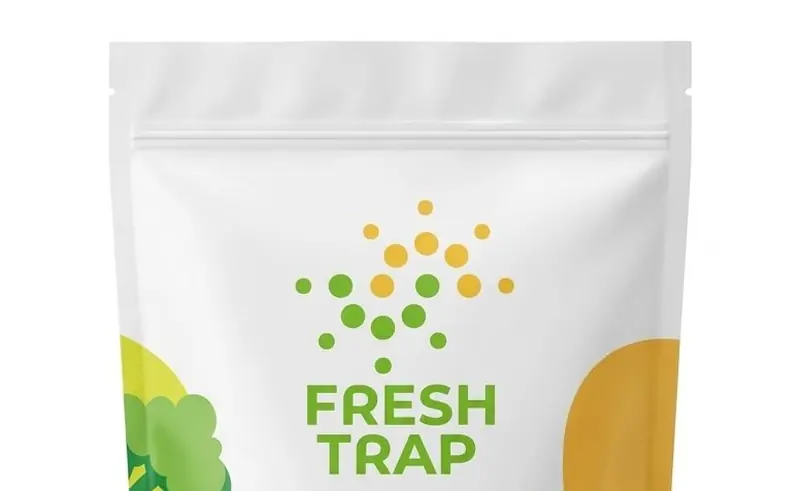
FreshTrap comes in a 400 g stand-up zip pouch of 800 sachets. Take out what the batch needs and close the zip straight away.
Away from food, feed and children
Store the pouches away from food and animal feed, and out of reach of children.
Shipping the sachets
The sachets are not classed as a dangerous good under IMDG, IATA or DOT transport rules (FreshTrap SDS, section 14).
Questions
Using FreshTrap: short answers
Does FreshTrap work in an open space or a vented carton?
FreshTrap works only in an enclosed space: a sealed carton, cold room or container. The gas has to stay with the produce for the whole 12–24 hours, so if your cartons have vent holes, talk to us before you treat and we will set the method with you.
Can I treat a whole cold room or container?
The 0.03% sachet is made for cartons and parcels. For a whole cold room there is a tablet format, and for a whole container a powder format; both are supplied on request. Talk to our technical team about your room or route.
Can I use FreshTrap at home or in a fridge?
No, it is not supplied for home use. FreshTrap is supplied for commercial use in enclosed spaces — cartons, cold rooms and containers.
Next step
Start with a trial on your own crop
Same crop, same storage, same day, side by side. We set the dose with you, run the first treatment together and photograph both lots from day 0.
Request a trial on your crop Request a quote Talk to our technical team
References
Regulatory lines describe the active ingredient 1-MCP, not FreshTrap. Last updated .
Hu et al. (2017). BioResources 12(1):2234–2248 — plants form new receptors over time; the effect is a delay (review). bioresources.cnr.ncsu.edu
Li L., Lichter A., Chalupowicz D. et al. (2016). Postharvest Biology and Technology 111:322–329. doi:10.1016/j.postharvbio.2015.09.031 — non-climacteric fruit: effects small, mostly on green tissue.
Satekge & Magwaza (2022). International Journal of Fruit Science 22:595–607. doi:10.1080/15538362.2022.2085231 — efficacy depends on maturity, dose, cultivar, temperature, packaging and timing.
Wasala W.M.C.B. et al. (2021). Asian Research Journal of Agriculture 14(1):44–56. doi:10.9734/ARJA/2021/v14i130118 — banana review: response depends on maturity; uneven ripening possible, so the dose must be controlled.
Watkins (2006). Biotechnology Advances 24:389–409. doi:10.1016/j.biotechadv.2006.01.005 — review: 1-MCP slows senescence but does not control decay.
Watkins (2008). HortScience 43:86–94. doi:10.21273/HORTSCI.43.1.86 — the dose must delay ripening, not block it.
Zhang, Ma, Dong, Terry, Watkins, Yu (2020). Horticulture Research 7:208. doi:10.1038/s41438-020-00405-x — meta-analysis of 292 papers on climacteric fruit; mango responds less consistently.
40 CFR §180.1220 — 1-methylcyclopropene; exemption from the requirement of a tolerance (US residue exemption, 2002). law.cornell.edu
USDA AMS, petitioned substance 1-methylcyclopropene — not permitted in USDA-certified organic handling. ams.usda.gov
