1-MCP (1-methylcyclopropene) can extend durian shelf life by delaying ripening after harvest. In published research on 1-MCP — not FreshTrap results — 'Monthong' durian treated with 0.5 ppm1-MCP for 12 hours at 25 °C and then stored at 15 °C kept for 30 days, against 18 days for untreated fruit (Amornputti et al. 2014).
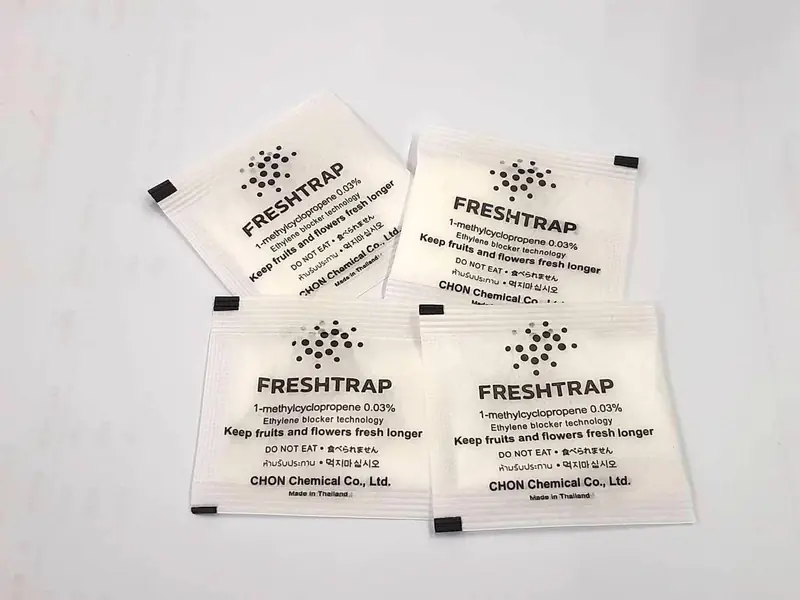
FreshTrap is CHON Chemical's 1-MCP sachet, synthesised and verified in Thailand. We have not yet run FreshTrap trials on durian — that is what the monitored trial is for: your fruit, your cartons, your cold room or container and your route, with the dose set with you.
12–24 hourstreatment in a sealed carton, cold room or container
Dose set with youin a monitored trial on your own durian
Why durian ripens fast
Why durian ripens so fast after harvest, and what 1-MCP changes
Durian is a climacteric fruit: it goes on ripening after it is cut. Ethylene is the natural hormone that tells produce and flowers to ripen and wilt, and ripening fruit gives off ethylene of its own, so the clock keeps running from the orchard to the buyer.
01
Ethylene gives the signal
Ethylene binds a receptor in the fruit's tissue and ripening goes on through grading, packing and the journey.
02
1-MCP takes the receptor
1-MCP binds the ethylene receptor about 10 times more strongly than ethylene itself (Blankenship & Dole 2003), so the ripening signal is held back.
03
The clock slows; it does not stop
It delays ripening rather than stopping it for good. Plants gradually form new receptors, so the effect of treatment wears off with time (Hu et al. 2017).
Because 1-MCP acts at the receptor, it holds back the response to ethylene from any source, the fruit's own included. An ethylene absorber works differently: it removes ethylene from the air around the fruit, while a ripening agent such as ethephon adds it.
Works only in an enclosed space — a sealed carton, cold room or container.
Schematic, not to scale. Receptor binding: Blankenship & Dole (2003).
Published research on 1-MCP — not FreshTrap results
What published research says about 1-MCP on durian
Independent research on the active ingredient, quoted with the treatment the authors used. The dose in this study is the researchers' own, not a FreshTrap recommendation, and the fruit was not treated with FreshTrap.
Storage life at 15 °C, in days · 'Monthong' durian · Amornputti et al. 2014 · published research, not FreshTrap results
Published research · 'Monthong' durian
Storage life at 15 °C:30 days against 18 untreated
'Monthong' durian was treated with 1-MCP at 0.5 ppm for 12 hours at 25 °C and then stored at 15 °C. The treated fruit kept for 30 days in storage; the untreated fruit kept for 18 days (Amornputti et al. 2014).
Treatment: 0.5 ppm1-MCP for 12 hours at 25 °C, then storage at 15 °C. One cultivar, one study.
Published research · what the result does not tell you
How to read this result
One cultivar, one dose and one storage temperature, in a research setting. It shows that 1-MCP can delay durian ripening; it does not tell you how a sachet will perform in your cartons, on your cultivar, at your temperature and on your route. How well a 1-MCP treatment works depends on the maturity of the fruit, the dose, the cultivar, the temperature, the packaging and the timing (Satekge & Magwaza 2022).
A result on your own fruit is what the monitored trial below is for.
No FreshTrap durian result yet: run the trial on your own fruit
We have not yet run FreshTrap trials on durian — that is what the monitored trial is for.
01
Tell us about the load
Your cultivar, how you pack (carton, cold room or container), the temperature you hold the fruit at and how long the journey takes.
02
We set the dose and treat with you
We design the dose for your fruit, your cartons and your journey, and run the treatment together.
03
Compare side by side
Control cartons and treated cartons packed the same day. Control and treated lots stored under the same conditions and photographed from day 0.
Same crop, same storage, same day — side by side. The result is measured on your fruit, in your cartons and on your route: the numbers that matter for your decision.
Dose, concentration, format and method are tailored to your container size and journey time; why this page carries no sachets-per-carton figure is explained under cautions. See how to use FreshTrap for the full method and handling notes, and FreshTrap for the product itself.
Thailand's fruit exports reached US$6.51 bn in 2024, led by durian at 859,183 tonnes (FreshPlaza 2024). If a trial shows the delay holds on your fruit, these are the gains to look for.
Longer transit life
Fruit that arrives in condition leaves the ripening decision to your buyer, rather than having ripened on the road or at sea.
Pick, pack and ship on separate days
Holding ripening back can help you spread a harvest peak: cut one day, pack the next, load when the truck or the vessel is ready.
Air to sea, where the days allow
On some routes a longer transit life is what makes sea freight worth considering where only air worked before. Whether that holds for your route is a question a monitored trial can answer.
Published research on 1-MCP — not FreshTrap results
Cautions: delay, not stop, and a dose set for your fruit
Five things to know before any durian goes into a treated carton.
It delays; it does not stop
1-MCP delays ripening rather than stopping it for good: plants gradually form new receptors, so the effect of treatment wears off with time, and treated durian will still ripen (Hu et al. 2017).
Published research on 1-MCP, not FreshTrap results — Hu et al. 2017, BioResources 12(1):2234–2248
The dose has to delay, not block
For most fruit the aim is a dose that delays ripening without blocking it (Watkins 2008). Too much can leave durian that does not soften and ripen normally, and eating quality at the destination is what your buyer pays for. That is why we publish no dose table and set the dose with you.
Published research on 1-MCP, not FreshTrap results — Watkins 2008, HortScience 43:86–94
One study, one cultivar
The published figure is for 'Monthong' durian stored at 15 °C (Amornputti et al. 2014). Response depends on maturity, dose, cultivar, temperature, packaging and timing (Satekge & Magwaza 2022), so your fruit may respond differently.
Published research on 1-MCP, not FreshTrap results — Amornputti et al. 2014, Postharvest Biol. Technol. 97:111–114; Satekge & Magwaza 2022, Int. J. Fruit Sci. 22:595–607
Not a fungicide, not a cold chain
Keep the temperature control, hygiene and careful handling you already use; the treatment adds to them rather than replacing them.
Published research on 1-MCP, not FreshTrap results — Watkins 2006, Biotechnol. Adv. 24:389–409
Climacteric fruit only
Durian responds to 1-MCP because its ripening is driven by ethylene. See all crops and uses.
Regulation
Registration and regulatory status
Registration with Thailand's Department of Agriculture is in progress.
The active ingredient, 1-MCP, is registered by the US EPA in other companies' products; FreshTrap is not EPA-registered.
By crop and by business, and which crops do not respond.
Learn more
Next step
Try FreshTrap on your durian before you decide
A monitored trial on your own fruit: control cartons and treated cartons packed the same day, stored the same way and photographed from day 0. We set the dose with you for your cultivar, your cartons and your journey, and run the treatment together.
Published research on 1-MCP — not FreshTrap results. Regulatory lines describe the active ingredient 1-MCP, not FreshTrap.
Amornputti S., Ketsa S., van Doorn W.G. (2014). Postharvest Biology and Technology 97:111–114. doi:10.1016/j.postharvbio.2014.06.011 — durian 'Monthong': 0.5 ppm1-MCP for 12 h at 25 °C, then storage at 15 °C; storage life 18 → 30 days.
Blankenship & Dole (2003). Postharvest Biology and Technology 28:1–25. doi:10.1016/S0925-5214(02)00246-6 — 1-MCP binds the receptor about 10× more strongly than ethylene; review.
Hu et al. (2017). BioResources 12(1):2234–2248 — plants form new receptors over time; the effect is a delay (review). bioresources.cnr.ncsu.edu
Satekge & Magwaza (2022). International Journal of Fruit Science 22:595–607. doi:10.1080/15538362.2022.2085231 — efficacy depends on maturity, dose, cultivar, temperature, packaging and timing.
Watkins (2006). Biotechnology Advances 24:389–409. doi:10.1016/j.biotechadv.2006.01.005 — review: 1-MCP slows senescence but does not control decay.
Watkins (2008). HortScience 43:86–94. doi:10.21273/HORTSCI.43.1.86 — the dose must delay ripening, not block it.
FreshPlaza (2024). Thailand's fruit exports hit $6.5 billion, driven by durian demand — Thailand's fruit exports reached US$6.51 bn in 2024, led by durian (859,183 t). freshplaza.com
US EPA.1-Methylcyclopropene pesticide fact sheet (PC code 224459), 2009 revision — first registered April 1999; enclosed spaces; low toxicity. www3.epa.gov
40 CFR §180.1220 — 1-methylcyclopropene; exemption from the requirement of a tolerance (US residue exemption, 2002). law.cornell.edu
FAO/WHO Codex Alimentarius pesticide index (checked 26 September 2026) — no Codex MRL for 1-MCP.fao.org
CHON ChemicalSynthesis services · FreshTrapHello! Ask us about a synthesis, a sample or FreshTrap. We reply as soon as we can.