
Safety data sheet (SDS)
For the FreshTrap 1-MCP 0.03% sachet: hazards, handling, storage and transport. Available on request.
Request the SDSLearn · Safety and regulation
1-MCP (1-methylcyclopropene), the active ingredient in FreshTrap, acts on a plant receptor, and its toxicity to people and animals is low; the gas dissipates after treatment.
FreshTrap is CHON Chemical's 1-MCP sachet, synthesised and verified in Thailand. Registration with Thailand's Department of Agriculture is in progress. Registrations and approvals abroad concern 1-MCP, the active ingredient; they are not claims about FreshTrap.
US · 40 CFR 180.1220Residue tolerance exemption for 1-MCP on fruit and vegetables
EU · to 31 July 2034Approval of 1-MCP as an active substance
Thailand
Registration with Thailand's Department of Agriculture is in progress.
Registrations and approvals abroad belong to the molecule, not to FreshTrap. The active ingredient, 1-MCP, is registered by the US EPA in other companies' products; FreshTrap is not EPA-registered. The details are under the active ingredient abroad.
We can show how the 1-MCP in FreshTrap is checked. Every batch: structure confirmed by NMR, content measured by GC-MS. The SDS and the product datasheet are available on request.
Until registration is complete, the safety information on this page describes the published international record for 1-MCP and our own batch analysis; it is not a regulatory claim. We quote no hazardous-substance class and no registration number before then.
Toxicity
1-MCP acts on a plant receptor; its toxicity to people and animals is low (oral LD50 in rats above 5,000 mg/kg — a literature value for 1-MCP). Wear gloves and eye protection when handling the concentrated powder. The gas dissipates after treatment; the US EPA exempts 1-MCP residues on fruit and vegetables from a tolerance (40 CFR 180.1220).
The US EPA's fact sheet on 1-methylcyclopropene reports low toxicity and describes its use in enclosed spaces (US EPA 2009). Each FreshTrap sachet (0.5 g) holds 1-MCP at 0.03% in an α-cyclodextrin carrier; moisture releases the gas inside the sealed carton, cold room or container. FreshTrap is supplied for commercial use in enclosed spaces — cartons, cold rooms and containers.
Safety positioning is based on the published international record for 1-MCP and on CHON Chemical's own batch analysis; it is not a regulatory claim pending completion of Department of Agriculture registration.
At work
The precautions are for the people who handle the sachets and the powder. Step-by-step directions are in how to use FreshTrap.
Residues
The gas dissipates after treatment; the US EPA exempts 1-MCP residues on fruit and vegetables from a tolerance (40 CFR 180.1220).
Residue rules are set market by market, so the answer depends on where your produce is sold. Below is what is on record for 1-MCP. For residue questions on your destination market, ask us — and check that market's own rules. Ask your importer what they need to know about the treatment, and whether they want documents with the shipment.
About 1-MCP, the active ingredient
1-MCP residues on fruit and vegetables are exempt from the requirement of a tolerance (40 CFR 180.1220, 2002).
Codex pesticide index, checked 26 September 2026
There is no Codex MRL (maximum residue limit) for 1-MCP.
Your destination market
Rules differ from one destination to the next. Check the residue rules of the market you ship to, and ask your importer what they need, before you ship treated produce.
The active ingredient abroad
These lines are about 1-MCP, the active ingredient, not about FreshTrap. The US registrations are for other companies' products.
The US EPA first registered 1-MCP in April 1999, for enclosed spaces only, and exempts its residues on fruit and vegetables from a tolerance (40 CFR 180.1220, 2002). EPA registration is per product; FreshTrap is not EPA-registered.
US EPA 2009; 40 CFR 180.1220
EU approval of 1-MCP runs to 31 July 2034 (Reg. (EU) 2019/1085). It concerns 1-MCP as an active substance, not FreshTrap.
Reg. (EU) 2019/1085
1-MCP is not permitted in USDA-certified organic handling. If you sell under another organic certification, check with that certifier.
USDA AMS
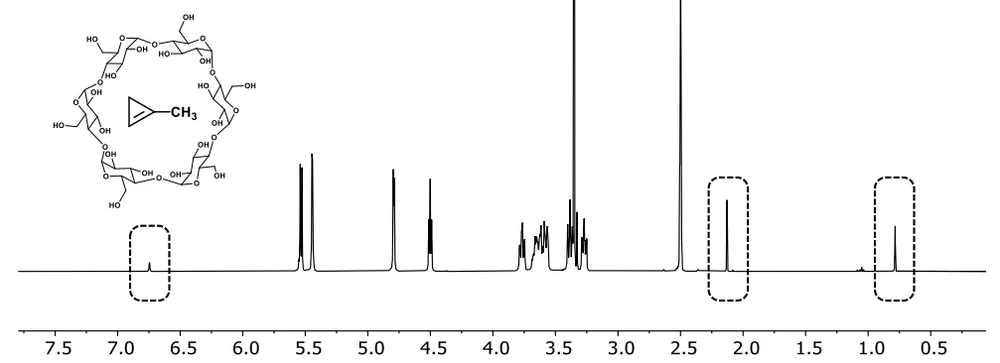
¹H NMR · chemical shift (ppm)
Our batch analysis
Every batch: structure confirmed by NMR, content measured by GC-MS.
Our safety information rests on two things: the published international record for 1-MCP, and our own analysis of each batch we make. NMR (nuclear magnetic resonance) confirms that the molecule in the batch is the one intended; GC-MS (gas chromatography–mass spectrometry) measures how much of it is there, with above 99% purity in every batch.
Quality control is not registration. It tells you what is in a batch; registration is the regulator's decision about the product. More on technology and quality.
Documents
We send these on request rather than as downloads. Tell us your crop, your format and your destination market, and we will send what applies.
For the FreshTrap 1-MCP 0.03% sachet: hazards, handling, storage and transport. Available on request.
Request the SDSWhat FreshTrap is, how to use it and who it is for. Available on request.
Request the datasheetNMR and GC-MS results for your batch. Available on request.
Request a CoA1-MCP acts on a plant receptor; its toxicity to people and animals is low (oral LD50 in rats above 5,000 mg/kg — a literature value for 1-MCP). The precautions are for the people who handle it: wear gloves and eye protection when handling the concentrated powder, and store the sachets away from food, feed and children. The SDS for the FreshTrap 0.03% sachet is available on request.
No. The active ingredient, 1-MCP, is registered by the US EPA in other companies' products; FreshTrap is not EPA-registered. EPA registration is per product.
No, it is not supplied for home use. FreshTrap is supplied for commercial use in enclosed spaces — cartons, cold rooms and containers.
No. According to its SDS (section 14), the FreshTrap sachet is not classed as a dangerous good under IMDG, IATA or DOT transport rules. The SDS is available on request.
No. A FreshTrap treatment releases a small dose of 1-MCP gas that holds back the plant's ripening signal. It is not a quarantine fumigation such as methyl bromide treatment, and it does not replace one where your destination market requires it. It does not control decay either: published research on 1-MCP — not FreshTrap results — finds that 1-MCP slows ripening and ageing but does not control decay (Watkins 2006).
Next step
Tell us what you ship and where it goes. We will send the datasheet and SDS, and answer residue questions for your destination market as far as the published record allows.
Regulatory lines describe the active ingredient 1-MCP, not FreshTrap. Published research on 1-MCP — not FreshTrap results.
US EPA. 1-Methylcyclopropene pesticide fact sheet (PC code 224459), 2009 revision — first registered April 1999; enclosed spaces; low toxicity. www3.epa.gov
40 CFR §180.1220 — 1-methylcyclopropene; exemption from the requirement of a tolerance (US residue exemption, 2002). law.cornell.edu
Commission Implementing Regulation (EU) 2019/1085 — EU approval of 1-MCP as an active substance to 31 July 2034. eur-lex.europa.eu
FAO/WHO Codex Alimentarius pesticide index (checked 26 September 2026) — no Codex MRL for 1-MCP. fao.org
USDA AMS, petitioned substance 1-methylcyclopropene — not permitted in USDA-certified organic handling. ams.usda.gov
Watkins (2006). Biotechnology Advances 24:389–409. doi:10.1016/j.biotechadv.2006.01.005 — review: 1-MCP slows senescence but does not control decay.
